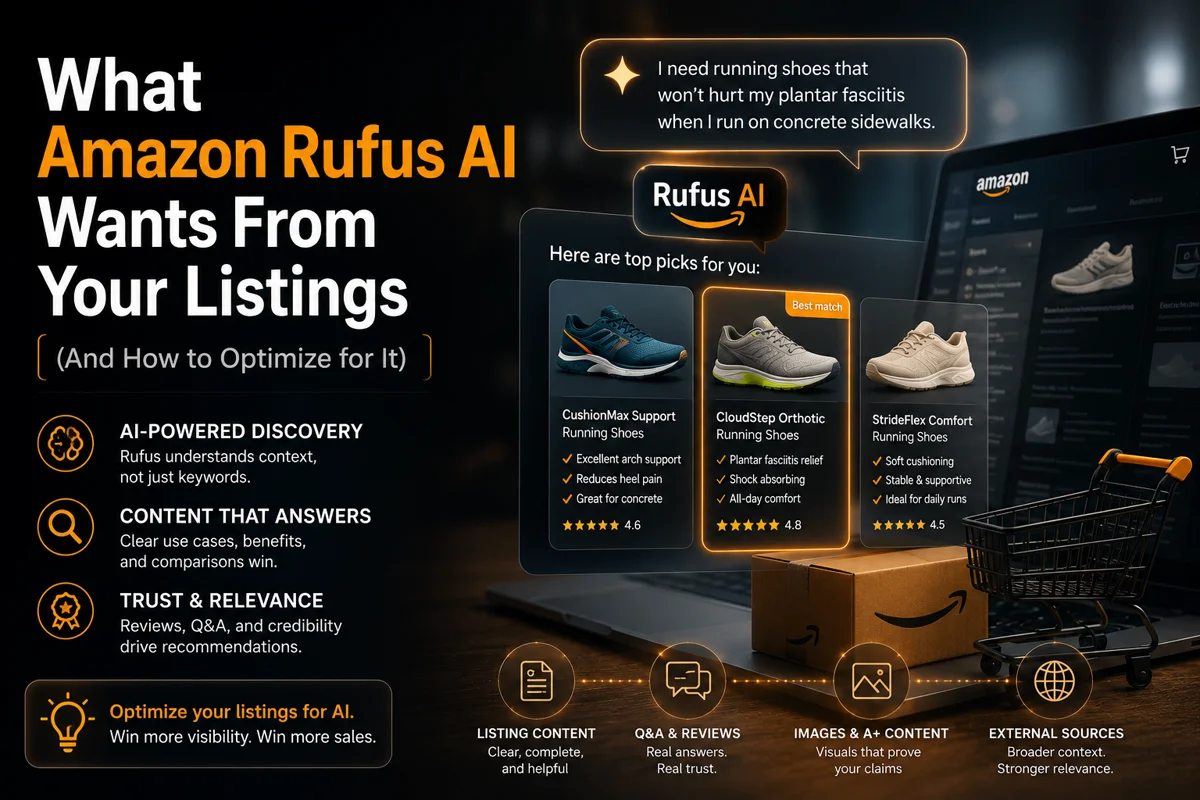
Amazon's search bar isn't the only way shoppers find products anymore.
What Rufus Actually Is
Rufus is Amazon's generative AI shopping assistant, launched in February 2024 as a US beta and rolled out broadly through 2024 and 2025. By 2026, it's available across the US, UK, Germany, France, Italy, Spain, Canada, and India, with continued expansion.
Built on Amazon Bedrock and powered by Amazon's COSMO knowledge graph, Rufus combines large language models with a semantic understanding layer that maps products, attributes, and use cases. COSMO reportedly contains 6.3 million nodes and 29 million edges connecting products to the contexts in which they're actually used.
The practical difference from traditional Amazon search is large.
A9 is transactional. A shopper types "running shoes for men," and Amazon returns listings ranked by keyword relevance and sales velocity.
Rufus is conversational. A shopper asks, "I need running shoes that won't hurt my plantar fasciitis when I run on concrete sidewalks." Rufus interprets the intent, draws on listing content, reviews, Q&A, and external sources, and recommends specific products with explanations of why each one fits.
The implications are significant. A listing optimized only for "running shoes" but lacking semantic connections to "plantar fasciitis," "shock absorption," and "hard surfaces" effectively disappears from this query. It's not ranked lower. It's removed from the consideration set because Rufus doesn't believe it answers the question.
Amazon's Q4 2025 earnings confirmed Rufus generated nearly $12 billion in incremental annualized sales, exceeding Amazon's own projections. Customers who engage with Rufus convert at meaningfully higher rates than those who don't. This is no longer an emerging feature. It's a discovery channel sellers can't afford to ignore.
Where Rufus Shows Up
Most sellers think of Rufus as a chat window. It isn't. Rufus is distributed across the Amazon shopping experience, surfacing in multiple touchpoints throughout the buyer journey.
The search bar. On desktop, Amazon now surfaces Rufus prompts directly in the search bar before standard results appear, based on the query the shopper is typing.
The search results page. A module called "Researched by AI" appears above traditional search listings. It's structurally similar to AI Overviews in Google search: a generative summary that condenses the results page into a decision layer.
Product detail pages. A "Why you might like this" module delivers a personalized explanation of why a specific product matches a shopper's preferences. An "Ask Rufus" option lets shoppers ask questions about a specific listing in context.
The cart. A "Compare with similar items" option launches Rufus directly for in-cart comparison, often right before checkout.
For sellers, this means Rufus visibility isn't a separate optimization track. It's woven through every stage of discovery and decision. A listing that performs well with Rufus is being recommended at multiple points in the funnel, not just one.
What Rufus Reads
Rufus pulls from multiple data sources to generate its recommendations. Understanding what it draws from is the first step in optimizing for it.
Your listing content. Title, bullets, description, A+ Content. Rufus reads these the way a knowledgeable assistant would, looking for use cases, comparisons, and context rather than exact keyword matches.
Your Q&A section. This has become one of the highest-leverage areas of any listing. Rufus actively indexes Customer Questions and Answers to handle edge-case queries. Listings with rich Q&A coverage get recommended significantly more often than listings with thin or empty Q&A sections.
Your reviews. Rufus treats user-generated content as ground truth. When generating an answer, it often cites reviews directly. You can't edit reviews, but the language in your reviews shapes how Rufus describes your product.
Your images, via computer vision. Rufus is multimodal. It reads images using computer vision and OCR. If your A+ Content claims "waterproof," but your images don't visually prove it, Rufus treats the claim as weak. Conversely, infographics with on-image text are now machine-readable in a way they weren't before.
External sources. This is the part most sellers don't realize. The "Researched by AI" module pulls from industry blogs, publications, videos, and authoritative content outside of Amazon. A competitor with a single mention in a well-indexed trade publication may outrank a fully optimized Amazon listing if Rufus reads that external source as more contextually relevant.
What Rufus Actually Wants
Across hundreds of teardowns by Amazon agencies and SEO researchers, a consistent picture has emerged of what Rufus rewards.
Natural language, not keyword stuffing. A title that reads "Orthopedic Memory Foam Dog Bed for Large Breeds with Joint Pain, Washable Cover, Supports Hip and Spine Health During Sleep" outperforms "Dog Bed Large Dog Bed Washable Memory Foam Orthopedic Pet Bed Dog Beds." The first reads like a knowledgeable human. The second reads like a keyword field, and Rufus penalizes that.
Use-case clarity. Products positioned for exactly one use case miss Rufus-mediated discovery for adjacent use cases. Strong listings name multiple realistic use cases explicitly.
Comprehensive Q&A coverage. Sellers building 15 to 20 substantive Q&A entries per ASIN are seeing meaningfully better Rufus surfacing than sellers with 2 or 3 generic answers. The Q&A section has effectively become an SEO field.
Detailed A+ Content with semantic depth. Basic A+ modules with stock copy no longer differentiate. The listings that win Rufus surfacing have A+ content that addresses specific buyer objections, compares against alternatives, and uses image alt text and on-image copy that aligns with the same semantic claims as the body copy.
Image evidence for every claim. If your listing says "fits in a kitchen drawer," your images should show it in a kitchen drawer. Rufus reads images, and unsupported claims weaken its confidence in your listing.
Consistency across the listing. Title says one thing, bullets say another, A+ Content says a third. This used to be a minor SEO issue. Now it actively confuses Rufus, which downweights listings where the semantic signals don't reinforce each other.
What Rufus Ignores or Penalizes
Keyword stuffing. Repeating the same phrase across title, bullets, and backend doesn't add semantic value. It signals low quality to Rufus and can hurt visibility on conversational queries.
Generic "best in class" claims with no specifics. Rufus is trained to look for evidence. "Premium quality" with no detail means nothing. "316 stainless steel construction tested to 500 dishwasher cycles" means everything.
Thin Q&A and review sections. Listings with 1-2 Q&As and few reviews give Rufus little to work with. Even if the product is excellent, Rufus can't confidently recommend it.
Single-channel listing strategy. A listing optimized perfectly on Amazon but with no presence in external publications will lose Rufus surfacing to competitors with weaker listings but stronger external citation footprints.
Mismatched product variations. Parent-child structures where variants have inconsistent attributes or category nodes confuse Rufus and reduce surfacing across all variants.
The 5-Step Rufus Optimization Workflow
A practical sequence sellers can run on their top ASINs:
Step 1: Ask Rufus directly what it thinks of your product. Open the Amazon app, find your product, and use the "Ask Rufus" feature on the detail page. Ask questions a real shopper might ask. Note where Rufus is confident and where it hedges. The gaps tell you exactly what's missing from your listing.
Step 2: Audit your Q&A section. Count substantive Q&As (not single-word answers). Target 15-20 per ASIN for products doing meaningful volume.
Step 3: Expand use-case language. List every realistic use case for your product, including secondary ones you might have ignored. Work them into bullets, description, and A+ Content. Don't be subtle.
Step 4: Add image evidence for every claim. Audit every major claim in your listing copy. For each one, ask whether an image visibly proves it. Build out new images where the gaps are.
Step 5: Build external semantic presence. Get your product mentioned in trade publications, review sites, comparison content, and authoritative blogs in your category. This is the slowest lever but increasingly the most important.
Why This Matters More Than Most Sellers Realize
Rufus is currently mediating an estimated 15-20% of Amazon mobile shopping queries, and that number is climbing each quarter. Traditional A9/A10 search still drives the majority of discovery, but the trend line is clear.
What makes this strategic, rather than just tactical, is the timing window. Listings optimized for Rufus now will accumulate authority before the topic gets crowded. The brands that figure this out in 2026 will lock in a 12-18 month advantage in their categories before the rest of the market catches up.
Most sellers are doing nothing about this. That's the opportunity.
How Dobby Ads Can Help
Optimizing for Rufus is a creative problem as much as a copy problem. The listings that win are the ones with strong semantic copy backed by image evidence, comprehensive A+ Content, and visual assets that reinforce the same claims across the listing.
Dobby Ads is an AI creative agency built for e-commerce brands. We produce hero images, A+ Content, lifestyle imagery, and listing creative designed to work for both traditional Amazon search and the new generation of AI-mediated discovery. Our process includes Rufus-aware copy audits for your top ASINs, A+ Content rebuilds with semantic depth Rufus can read, variant-specific creative production at scale, and image evidence assets that visually prove the claims your copy makes.
Frequently Asked Questions
What is Amazon Rufus?
Rufus is Amazon's generative AI shopping assistant, launched in February 2024 and integrated across the Amazon shopping experience as of 2026. It uses large language models and Amazon's COSMO knowledge graph to interpret shopper intent in natural language, rather than matching keywords literally.
Is Rufus replacing traditional Amazon search?
Not yet, but it's reshaping how shoppers discover products. As of early 2026, Rufus is estimated to mediate roughly 15-20% of mobile shopping queries on Amazon, with that share growing each quarter.
How does Rufus decide which products to recommend?
Rufus draws on multiple data sources: your listing content, your Q&A section, your reviews, your images (read via computer vision and OCR), and external sources like industry blogs and publications. It uses semantic understanding to match shopper intent with products that actually answer the question being asked.
What should I change on my Amazon listing to optimize for Rufus?
Five things matter most: natural-language copy instead of keyword stuffing, explicit coverage of multiple use cases, comprehensive Q&A coverage (15-20 substantive entries per high-revenue ASIN), images that visually prove your claims, and external semantic presence in trade publications or comparison content.
Does Rufus read product images?
Yes. Rufus is multimodal, meaning it uses computer vision and OCR to read product images, including text within infographics and A+ Content. Claims made in your listing copy that aren't visually proven in your images are treated as weaker signals.
How important are reviews and Q&A for Rufus visibility?
Very important. Rufus treats user-generated content as ground truth and often cites it directly when answering shopper questions. Q&A in particular has effectively become a new SEO field.
Who is Dobby Ads?
Dobby Ads is an AI creative agency built for e-commerce brands. We produce hero images, A+ Content, lifestyle imagery, and listing creative for Amazon, Shopify, and DTC channels, using AI tools where they earn their keep and human direction where it matters most.
How does Dobby Ads approach Rufus optimization?
We treat Rufus optimization as a creative problem, not just a copy problem. That means rebuilding A+ Content with semantic depth Rufus can read, producing image evidence assets that visually prove product claims, and producing variant-specific creative at the scale required to win across an entire product line.